


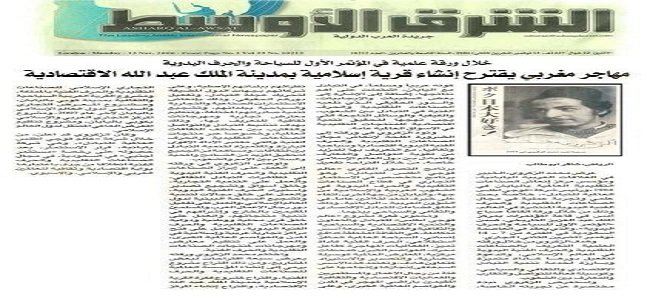
Mohamed Zekrioui, an Arab-Japan strategic relations expert and founder of the International Center for International Industrial Transformation in Japan in 1984, and managing director of the Fuji Atlas International Trade Company, presents conclusions from scientific and field studies of conventional-traditional industries and handicraft spread throughout world. It was presented this morning at the historic King Abdul Aziz Convention Hall at the First Convention on Tourism and Handicrafts held in the capital Saudi Arabia on November 7 to 14.
Mohamed Zekrioui's paper aims to introduce conventional and traditional industries and handicraft products to the Muslim world, while calling for the strengthening of the role of boosting economic transactions to better economic, cultural and tourism levels as a medium of intervention to bring the world and nation together.
In the meantime, he also spoke about the specific challenges he faced personally during his joint venture with Japan as he was an Arab Muslim, apart from sharing conclusions from his long journey that found positive and even negative elements. He also revealed the real role played in engaging in the conventional-traditional industry of cultural integration between the bloc of the nation in the world, sustainable methods and mediums need to be created to realize the future of the industry in the open market.
He also said in his paper that the importance of urgent reforms should be taken to ensure that the conventional-traditional industries and handicrafts are of the highest economic, tourism, and cultural relevance. This is to introduce the world to the industry further and strengthen trade relations between countries and connect the world community to cultural integration. Drawing on the idea, he published the Atlas Fuji World Integration talk program, a special program around trade investment in the conventional industrial sector and traditional handicrafts for Arab Muslims from one corner, from Japan to another based on his extensive experience in industry for thirty years in Arab-Japanese bilateral relations. The objective is to create more markets through the medium of economy, culture, tourism and so on.
The Fuji Atlas World Plan brings together the roles of integration and collaboration as well as the development of economics, tourism, culture and the arts, which have seven key fundamentals that complement each other. These include cultural diversity as a humanitarian factor, international tourism as a stepping stone, artistic career as a unifying factor, population change as a driving force, mega structure as a center, international expo as a medium of civilization development, import-export as a strategic cooperation. This principle is embodied in the involvement of businessmen other than investors, economic interactions, culture, immigrant support, and international infrastructure.
Zekrioui also included messages in his writings to work to capitalize on the conventional-traditional industries and handicrafts to support cultural integration efforts, as well as to promote trade sectors, open new market opportunities, encourage production, and import handicraft products, and encourage international tourism in the Islamic world, assisting the efforts of businessmen and immigrants abroad and their participation to increase their output, establish local, national and international industrial-traditional industrial villages, open Arab-Islamic trading centers in cities with mega infrastructure, and organizes expos including festivals to promote handicrafts and traditional industrial products.
Zekrioui closed his presentation by proposing seven project-worthy recommendations. He also proposes the establishment of an international industrial and handicraft foundation and Islamic economic village plan in Bandar Abdullah. He also spoke on the construction of Islamic trading centers for Saudi Arabia's conventional and handicraft industry, as well as Arab tourism and cultural villages in Kobei City, Japan, and plans for an exports of tourism products for Islamic countries held in Japan by the end of 2007, the center Arab Islamic trade in Kobei, Japan, and international expo organizing projects and even Islamic countries.
Aziz Zakriwi also explained that, through investment licenses as foreign investors acquired in Saudi Arabia in the conventional and handicraft sectors, the Fuji Atlas International Trade Company (Japan) was able to move towards the economic-cultural gateway connecting the two Islamic worlds, Arab and Asia.